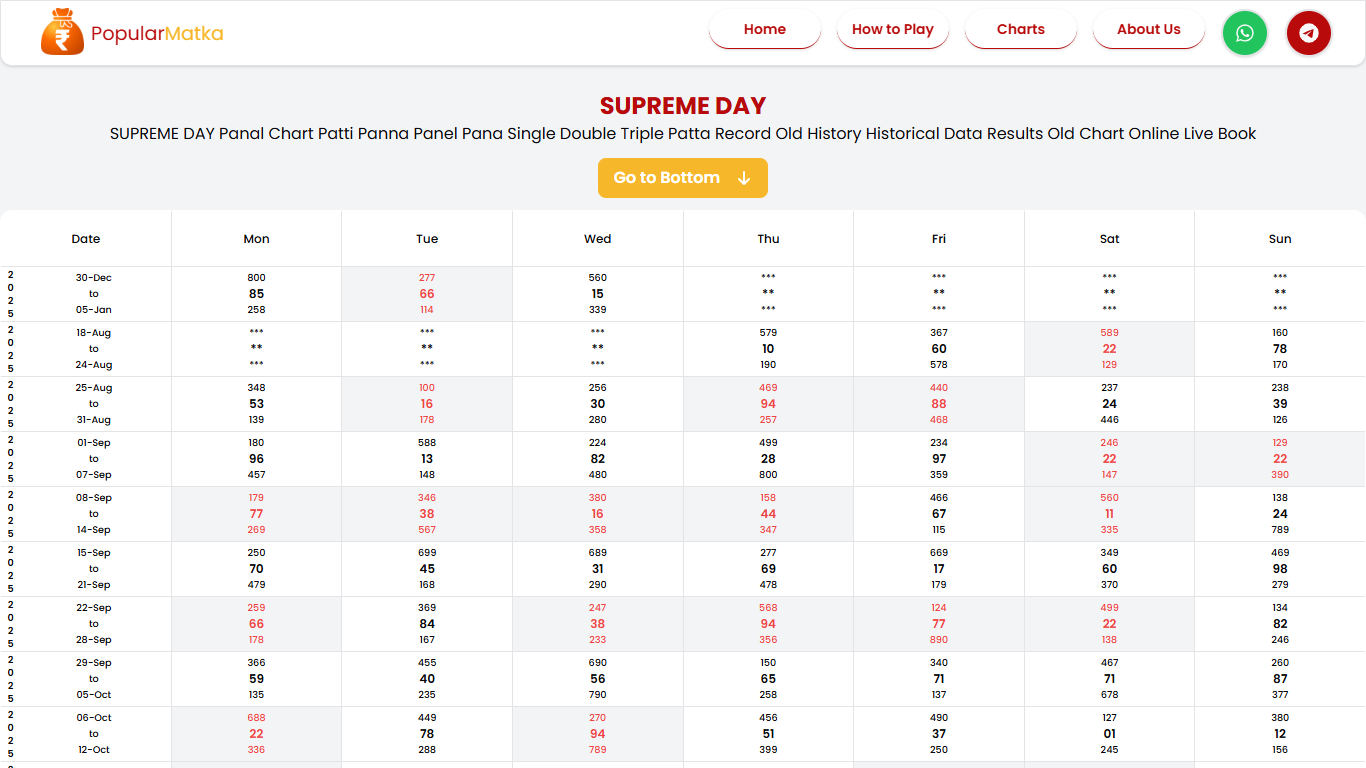
Supreme Day Matka charts are one of the most viewed elements by matka followers. These charts present daily results in an organized format, allowing users to review past outcomes and understand how numbers have appeared over time. While charts are often discussed in relation to patterns, it is important to approach them as records of historical data, not tools for prediction.
This article explains how supreme day matka charts are structured, how numbers are read, and what types of patterns are commonly observed—purely for awareness and educational understanding.
What Is a Supreme Day Matka Chart?
A Supreme Day Matka chart is a visual record of past daily results. It displays outcomes in a sequence so that users can easily see what numbers appeared on specific dates.
Charts usually include:
- Date-wise results
- Single digits, jodi, or patti formats
- Weekly or monthly groupings
- Continuous historical records
Once updated, chart entries remain unchanged.
Understanding the Number Formats in Charts
To read a chart correctly, it is important to understand the basic number formats displayed.
Single Digit
A one-digit number derived from the result. Singles are often shown clearly to help users scan charts quickly.
Jodi (Pair)
A two-digit number formed by combining two single digits. Jodi results are commonly highlighted in charts.
Patti / Panel
A three-digit number that represents a detailed result format. Patti numbers are usually displayed in structured columns.
These formats are used for display and record purposes only.
How to Read a Supreme Day Matka Chart
Reading a chart is straightforward:
- Start with the date column
- Move across to view the result number
- Follow the sequence day by day
- Observe how numbers change over time
Charts are designed to make historical tracking simple and clear.
Commonly Observed Patterns in Charts
When reviewing Supreme Day Matka charts, users often notice certain patterns. These patterns are observations, not indicators of future outcomes.
Repetition
The same number or digit appears multiple times within a short time span.
Gaps
Certain numbers may not appear for long periods.
Sequences
Numbers may seem to move upward, downward, or alternate over several days.
Mirror or Family Numbers
Digits that are visually or numerically related may appear close together.
Such patterns naturally occur in random data and do not follow fixed rules.
Why Patterns Appear Meaningful
Human perception plays a major role in chart analysis. The brain naturally looks for order, which can make random sequences appear meaningful.
Factors that influence perception include:
- Visual grouping in charts
- Recent repetitions standing out
- Long gaps creating expectations
Understanding this helps prevent overinterpretation of chart data.
What Charts Can and Cannot Tell You
Charts Can:
- Show historical results
- Help verify past outcomes
- Provide organized records
- Improve result awareness
Charts Cannot:
- Predict future results
- Guarantee repetitions
- Reveal hidden formulas
- Control outcomes
Keeping this distinction is essential for responsible understanding.
Common Misunderstandings About Chart Analysis
Some common misconceptions include:
- Believing repeated numbers must continue
- Assuming missing numbers are “due”
- Treating patterns as reliable systems
In reality, each Supreme Day Matka result is independent of previous days.
Responsible Way to Use Chart Information
Chart analysis should be used only for:
- General information
- Educational understanding
- Historical reference
- Result verification
Avoid treating chart patterns as decision-making tools.
Conclusion
Supreme Day Matka chart analysis is best understood as the process of reading and reviewing historical number records. While patterns such as repetition, gaps, or sequences may appear, they are natural occurrences in random data and do not influence future outcomes.
By viewing charts with clarity and awareness, readers can better understand Supreme Day Matka information without confusion or unrealistic expectations.
2 thoughts on “Supreme Day Matka Chart Analysis: Reading Numbers and Patterns”
Comments are closed.